After quite some time, I picked up debvulns again to implement what I mentioned in my previous post: exporting reboot required status and identifying services that need a restart. Additionally, I wanted to ensure kernel vulnerabilities are not marked as fixed unless the running kernel matches or exceeds the fixed version. Both features are now live in version 0.2.4 (intermediate release 0.2.3 only included the needrestart functionality).
Why needrestart?
When you update packages on a system, security fixes do not take effect until running processes actually use the updated binaries from disk. When an upgrade occurs, existing processes continue executing the older, vulnerable code loaded into memory, while only newly spawned instances pick up the fixed binary. The needrestart package in Debian exists specifically for this purpose. It can run in either report mode or action mode: report mode provides machine-readable output, while action mode automatically restarts affected services.
Why integrate needrestart into debvulns?
needrestart is a standalone utility that can run independently or hook into apt to run automatically after an upgrade. On desktop systems, it typically runs interactively with a TUI prompt; on headless servers, it can be set to take non-interactive default actions. In batch mode, it avoids restarting sensitive system components (such as dbus) to prevent destabilizing the session.
Integrating this into debvulns is not about replacing needrestart or debsecan, but rather bringing vulnerability and remediation state into a single, discoverable interface. debvulns aggregates these signals into a standard format—in this case, Prometheus metrics and tags that can be visualized in Grafana, monitored by alerting systems, or consumed downstream by automation tools.
Why Special Handling for Kernel?
Just as user-space daemons require a restart after patching, a patched kernel requires a system reboot into the new image before the vulnerability is truly mitigated. Previously, debvulns only verified whether the patched package version was installed on disk. If the deb package was installed, the CVE was marked as resolved, which creates a false sense of security while running the old kernel.
With this release, debvulns now checks the active running kernel release. A kernel vulnerability is considered resolved only when the system is running the fixed kernel version. Until a reboot happens, the system remains reported as vulnerable.
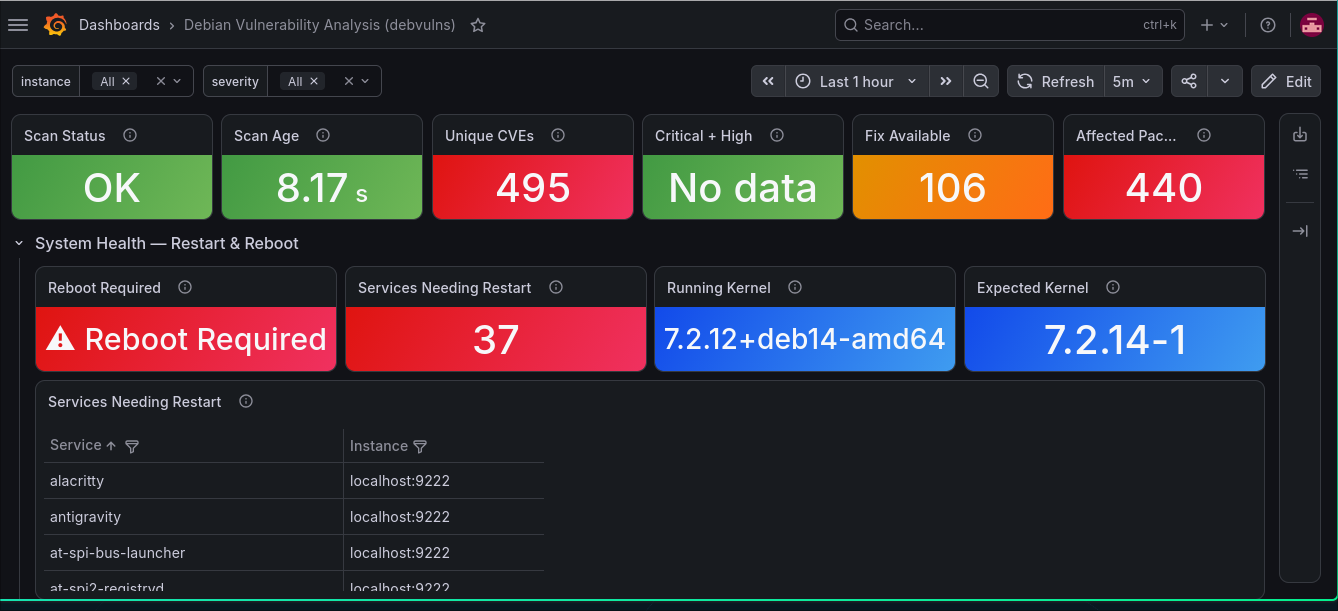
The updated dashboard reflects these changes below. It will need further polish, but key metrics and restart/reboot states are now visible:
What Next?
These were the two pending functional areas I wanted to cover, and no further major features are planned for now. Next up will be reviewing the entire codebase to identify potential optimizations and remove any unnecessary complexity. I haven't done a full pass through the repository since the initial skeleton implementation, so testing edge cases and cleaning up the internals will be the main focus. This will likely take some time since I only hack on this during weekend downtime. Until then, happy hacking, give the new release a try, and file an issue if you run into bugs.